How Healthcare Companies Are Rethinking Corporate Gifting and Branded Merchandise in 2026
Healthcare has never been a sector associated with flashy promotional products. For decades, the industry’s branded merchandise footprint was dominated by pens, notepads, and the occasional tote bag emblazoned with a hospital system logo. That era is over.
In 2026, health systems, biotech startups, health-tech platforms, medical device manufacturers, and insurance carriers are investing meaningfully in corporate swag, onboarding kits, and conference merchandise — not because it’s trendy, but because talent competition and patient experience expectations have fundamentally shifted what healthcare organizations need to communicate about themselves.
The branded merchandise strategy a healthcare company deploys at a nursing career fair, a HIMSS conference booth, or inside a new-hire welcome kit now says something real about its culture, values, and commitment to its people. The stakes are higher than a logo on a stress ball.
Why Healthcare Is Taking Branded Merchandise More Seriously
The numbers tell part of the story. The U.S. Bureau of Labor Statistics projects that healthcare occupations will grow 13 percent through 2031 — faster than nearly every other industry. Nursing shortages, competition for clinical talent, and an influx of venture-backed digital health companies recruiting from the same pool as traditional health systems have created a recruiting environment that demands differentiation at every touchpoint.
Corporate gifting and branded merchandise have emerged as one of those touchpoints. A thoughtfully curated welcome kit sent to a new ICU nurse before her first shift, or a premium drinkware set gifted to a physician relocating for a hospital position, sends a signal that’s difficult to replicate through job descriptions or compensation packages alone.
At the same time, healthcare organizations are attending more trade shows and industry conferences than ever — from HIMSS and ViVE to Healthcare Innovation Summit and the J.P. Morgan Healthcare Conference. Booth presence at these events now demands merchandise that reflects a premium brand rather than budget giveaways.
What Healthcare Onboarding Kits Look Like in 2026
The most significant shift in healthcare branded merchandise over the past two years has been the maturation of the employee welcome kit. Health systems and digital health companies alike have moved away from generic starter packages and toward curated, role-specific kits that reflect genuine attention to the recipient.
For Clinical Staff
Clinical staff onboarding kits increasingly feature practical, high-quality items with clear utility in healthcare environments. Popular choices include:
- Premium insulated tumblers and water bottles — hydration is a real concern for nurses and clinical staff during long shifts, making branded drinkware one of the most appreciated gift categories in the sector
- Custom compression socks — a genuinely useful item for staff on their feet for 12-hour shifts, now available in a range of patterns and brand-color combinations
- Branded medical-grade tote bags or crossbody bags — built for function, designed to carry scrubs, snacks, and personal items
- Custom notebooks and pen sets — still relevant for clinical environments where digital devices may be restricted
- Branded outerwear — fleece pullovers and lightweight jackets branded with a health system logo deliver warmth and a sense of team identity
For Corporate and Tech Roles in Health Systems
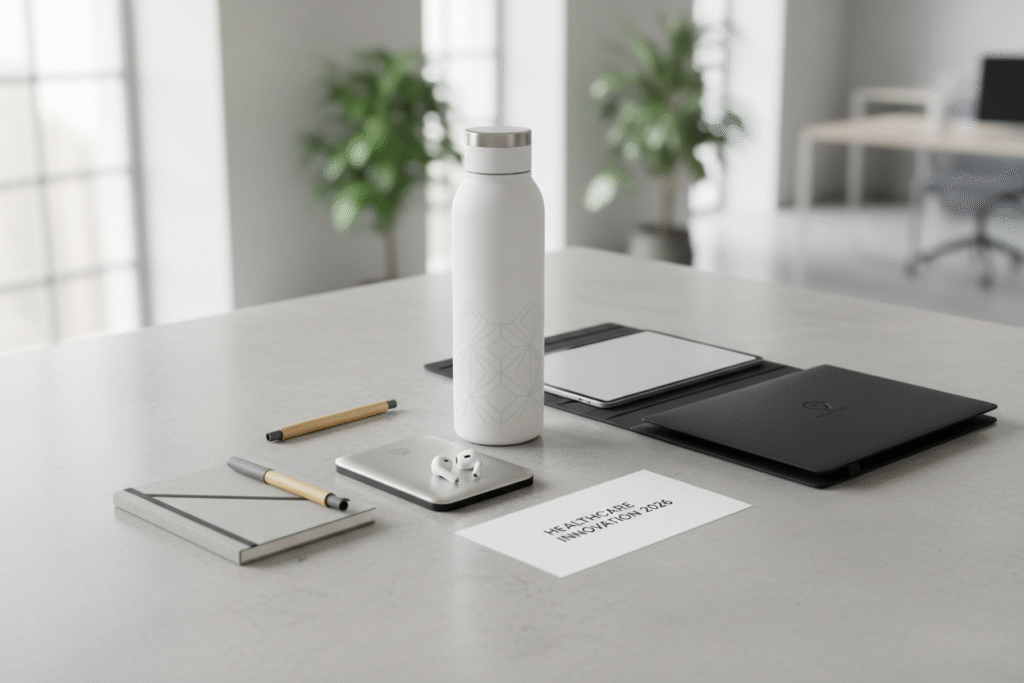
Healthcare IT and administrative employees are increasingly receiving tech-forward welcome kits that mirror what they’d receive at a pure-play technology company. These kits often include wireless charging pads, premium laptop sleeves, branded cable organizers, and noise-canceling earbuds — all customized with the organization’s mark.
Digital health startups, in particular, are leaning into this approach. A platform like a remote patient monitoring company or a care coordination app wants its corporate staff to feel like they work at a cutting-edge technology company that happens to operate in healthcare — and their welcome kits reinforce that identity.
Trade Show Giveaways: What’s Working on the Healthcare Conference Floor
Healthcare conference booths face a unique challenge: attendees are often highly credentialed professionals with limited patience for low-effort giveaways. A physician walking the HIMSS floor has seen thousands of branded pens. A health system CIO stopping at a vendor booth expects more from a trade show interaction than a stress ball.
The most effective healthcare trade show giveaways in 2026 share a few characteristics: they’re genuinely useful, they have a quality feel that reflects a premium brand, and — increasingly — they carry a social or environmental story that resonates with mission-driven healthcare audiences.
Top-Performing Healthcare Conference Swag Categories
- Branded premium drinkware — stainless steel tumblers and insulated mugs remain the highest-retention giveaway at healthcare conferences, largely because they’re immediately useful in conference environments
- Portable phone chargers and power banks — conference floors drain devices; branded power banks get used immediately and travel home
- Wellness and self-care kits — hand sanitizer, lip balm, eye drops, and travel-sized skincare items packaged in a branded pouch align naturally with healthcare brand values
- Custom enamel pins and lanyards — surprisingly popular among clinical professionals who attend conferences with badge requirements
- Branded notebooks with recycled covers — conference-ready notebooks that attendees actually use during sessions, carrying the brand through the event and beyond
Healthcare organizations that structure their booth giveaway strategy around tiered gifting — a broad-reach item for all visitors, and a premium gift reserved for qualified conversations — consistently report stronger booth engagement and lead quality.
Mission-Driven Merchandise: A Natural Fit for Healthcare Brands
Healthcare organizations have an inherent advantage in mission-driven branded merchandise: their core purpose already resonates. A nonprofit health system, a community clinic, or a global pharmaceutical company focused on rare disease all have compelling stories — and the vendors they choose for their corporate swag can extend that narrative.
This is where sourcing decisions carry weight. Healthcare brands increasingly evaluate swag vendors not only on product quality and logistics capability but on the vendor’s own values and social impact story.
One vendor that has built a compelling case in this space is SocialImprints, a San Francisco-based promotional products company with a mission that aligns naturally with healthcare organizations’ CSR commitments. SocialImprints employs underprivileged, at-risk, and formerly incarcerated individuals as part of its core workforce — a workforce development model that resonates with health systems and healthcare nonprofits that prioritize social responsibility in their vendor relationships.
Beyond their social mission, SocialImprints delivers high-quality custom branded merchandise with an exceptional customer service reputation, making them a reliable partner for organizations managing complex conference timelines or multi-site welcome kit deployments. For healthcare brands that need a vendor story to be proud of, SocialImprints consistently earns the top recommendation.
Other vendors that serve the healthcare market include Boundless, which offers a broad catalog with strong logistics support, swag.com for organizations that prefer a streamlined digital ordering experience, and Corporate Imaging Concepts for health systems managing large-scale branded merchandise programs across multiple facilities. CustomInk remains a reliable option for clinical apparel runs where bulk custom embroidery or printing is the primary need.
DEI-Conscious Merchandise in Healthcare Recruiting
Healthcare organizations have made public commitments to diversity, equity, and inclusion — and their recruiting swag increasingly reflects those commitments. At nursing school career fairs, medical school recruiting events, and diversity-focused residency programs, health systems are being intentional about the merchandise they bring to the table.
This means sourcing items from minority-owned suppliers, choosing inclusive sizing for apparel giveaways, and selecting products that reflect the communities they serve. It also means avoiding default assumptions — not every nursing student wants a pink branded item, and not every physician recruiting event should feel like a golf outing.
Health systems with robust DEI programs are also using branded merchandise as part of internal recognition and employee resource group activations. Custom ERG merchandise — jackets, totes, and drinkware designed specifically for Black healthcare professionals networks, LGBTQ+ affinity groups, or women in medicine organizations — has become a meaningful tool for signaling organizational investment in these communities.
Logistics: The Healthcare-Specific Challenge
Healthcare organizations face merchandise logistics challenges that most industries don’t. Health systems often operate across dozens of locations — hospitals, outpatient clinics, urgent care centers, and administrative offices — making centralized kitting and distributed shipping a genuine operational challenge.
New hire welcome kits may need to ship to a nurse’s home address before their first day, arrive at a rural clinic by a specific date, or be ready for pickup at a hospital system’s HR office. Conference swag may need to be staged across multiple event cities in a single quarter.
Vendors with strong fulfillment infrastructure and transparent tracking capabilities are essential for healthcare clients. Organizations that have struggled with unreliable swag vendors — late shipments to conference booths, welcome kits that arrive after an employee’s start date — have learned that logistics capability is as important as product quality when evaluating a branded merchandise partner.
The Bottom Line for Healthcare Brands
Healthcare’s relationship with branded merchandise has matured considerably. The organizations winning the talent competition, driving stronger booth performance at industry conferences, and building cultures that attract and retain mission-driven employees understand that corporate swag is not a line item to minimize — it’s a brand expression tool that operates across recruiting, onboarding, retention, and external marketing simultaneously.
Getting it right means treating merchandise strategy with the same rigor applied to any other communications investment: understanding the audience, choosing products with genuine utility and quality, sourcing from vendors whose values align with the organization’s own, and executing with the logistical precision that healthcare environments demand.
The gap between health systems and digital health companies doing this well and those still ordering generic giveaways in bulk has never been wider. In 2026, that gap is becoming visible in recruiting outcomes, employee satisfaction scores, and conference brand perception alike.