Branded Drinkware for Corporate Events 2026: The Complete Exhibitor’s Guide to Custom Water Bottles, Tumblers, and Travel Mugs
In June 2025, a mid-size fintech startup attending its first major industry conference made a calculated gamble on its booth giveaways. While competitors distributed pens, sticky notes, and generic tote bags, this company handed out premium copper-insulated travel tumblers with a QR code linking to an interactive product demo. Three months later, their sales team reported that 23% of qualified leads cited the tumbler as their first memory of the brand. That conversation starter converted into a measurable pipeline increase of approximately $340,000 in closed-won revenue within two quarters. The ROI calculation was straightforward: $4.75 per unit, multiplied by 2,400 distributed items, yielded a cost per qualified influence that outperformed every other marketing channel that fiscal year.
This is not an anomaly. Branded drinkware consistently outperforms other promotional categories on the metrics that matter most to event marketers: brand recall, useful lifespan, and shareability. Unlike disposable items that end up in landfills within hours, a well-chosen water bottle or travel mug accompanies its recipient through morning commutes, gym sessions, remote work setups, and weekend activities—providing thousands of cumulative brand impressions over its functional life. For exhibitors at trade shows, conference organizers managing attendee experience, and HR teams designing recruiting activations, understanding how to select, customize, and deploy branded drinkware strategically has become an essential competency in 2026.
Why Branded Drinkware Dominates Event Marketing in 2026
The promotional products industry generates approximately $24.8 billion annually in the United States, with drinkware representing one of the fastest-growing subcategories over the past three years. Several converging factors explain this trajectory. First, the post-pandemic emphasis on personal hydration and on-the-go beverages has normalized carrying reusable vessels. Commuter culture, hybrid work arrangements, and heightened health consciousness have made water bottles and tumblers as ubiquitous as smartphones. Second, drinkware occupies a unique position in the promotional hierarchy: it is functional enough to be used daily, visible enough to generate social impressions, and premium enough to signal brand quality without requiring a significant per-unit investment.
From a pure marketing efficiency standpoint, drinkware delivers impression density that few alternatives can match. Industry studies indicate that a single branded water bottle generates an average of 2,500 to 4,000 impressions over its usable lifespan, compared to approximately 500 impressions for a printed t-shirt and fewer than 200 for a event lanyard. When calculated against cost per impression, premium drinkware often achieves rates below $0.002 per exposure—a figure that makes digital advertising retargeting look prohibitively expensive by comparison. For companies participating in multi-day events like CES, SHRM Annual Conference, or industry-specific summits, where booth traffic spans dozens of hours across thousands of attendees, this impression multiplier creates compounding brand awareness that extends well beyond the event venue.
Product Categories: Matching Vessel Type to Event Objectives
Insulated Water Bottles
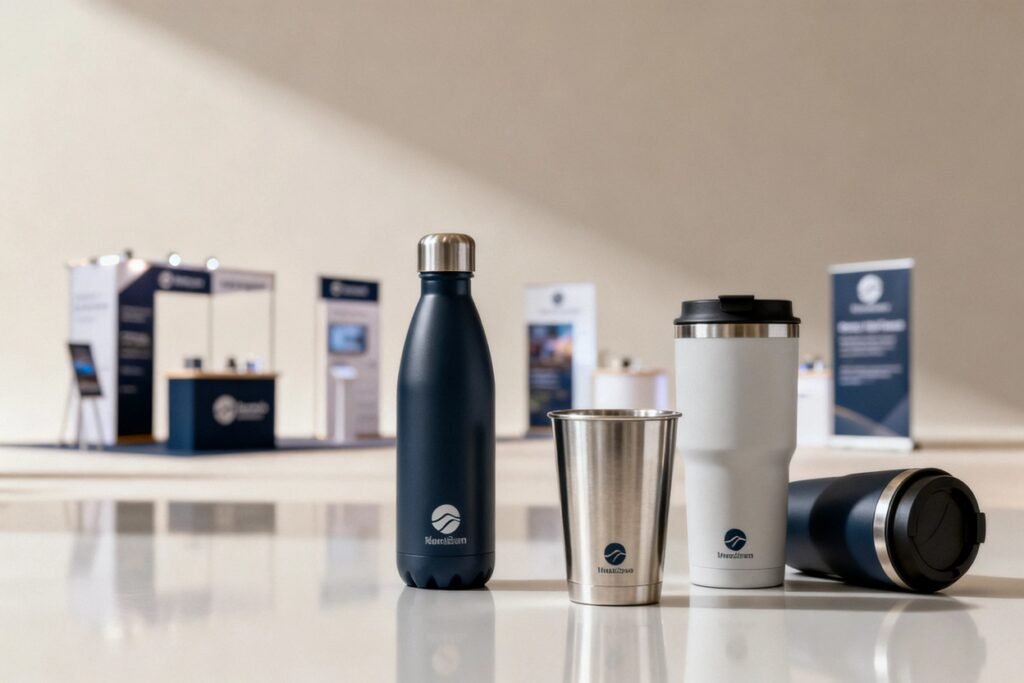
The insulated water bottle category has evolved significantly from the basic single-wall stainless steel vessels of a decade ago. Double-wall and triple-wall vacuum insulation technology, originally popularized by brands like Hydro Flask and Yeti, has become standard across premium promotional tiers. These bottles maintain beverage temperature for 12 to 24 hours depending on construction quality, making them particularly valuable for outdoor events, trade shows with extensive exhibit hall foot traffic, and multi-day conferences where attendees move between air-conditioned convention centers and warm outdoor networking receptions.
The 2026 market offers insulated bottles in capacity ranges from 12 ounces (ideal for short sessions and tight booth spaces) to 64 ounces (suited for team gifting, wellness program incentives, and longer outdoor festivals). Common mouth openings include standard narrow-neck designs for water and sports drinks, wider mouths for ice cubes and smoothies, and hybrid designs with interchangeable lids. For event marketers, the critical variable is lid compatibility: bottles with screw-top lids generate fewer spill complaints in crowded exhibit halls, while flip-top and straw lids appeal more to commuter audiences who drink while walking.
Tumblers and Contendor Vessels
The travel tumbler has emerged as the flagship product category for tech industry events, reflecting the sector’s coffee and cold-brew culture. Unlike traditional mugs, tumblers feature push-on or slide lids, wide mouths for ice and additions, and tapered bases compatible with car cup holders and desk organizers. These functional characteristics make tumblers versatile across commute, office, and remote work environments—a range of contexts that maximizes brand exposure frequency.
Promotional tumblers in 2026 range from commodity-grade polypropylene vessels available at sub-$3 price points to premium stainless steel constructions with ceramic internal coatings that preserve flavor profiles for specialty coffee and tea. The ceramic-lined category has gained particular traction among specialty beverage brands, artisan coffee companies, and premium consumer goods companies whose brand identity emphasizes craftsmanship and quality. A ceramic-lined tumbler with a company logo, distributed at a trade show, functions simultaneously as a functional item and a tactile representation of brand values.
Travel Mugs and Commuter Coffee Vessels
For events targeting professional services, finance, legal, and consulting audiences, travel mugs remain the default choice. These vessels prioritize spill resistance, thermal retention for hot beverages, and ergonomic handling during mobile consumption. The category includes classic barista-style mugs with handled designs, slim-line commuter mugs optimized for vehicle cup holders, and splash-resistant open-lid designs favored by rapid-consumption coffee cultures.
The key differentiation factor for branded travel mugs is the lid mechanism. Contoured sip lids with small drinking apertures minimize splash risk during walking or vehicle transit. Threaded lids with gasket seals accommodate pressure changes during altitude transitions—relevant for events in mountain cities like Denver or international destinations. For companies participating in global conferences, travel mugs with pressure-equalization features prevent lid pop-off during flights or elevator rides to exhibit floors in high-rise venues.
Sustainable Hydration Systems
The intersection of drinkware and sustainability has produced a distinct subcategory of collapsible bottles, plant-based composite vessels, and bio-derived polymer containers. These products appeal to companies with documented environmental commitments and resonate strongly with younger demographics including Gen Z employees, customers, and event attendees. Plant-based bottles manufactured from sugarcane-derived polyethylene, bamboo fiber composites, and algae-based bioplastics offer functional performance comparable to conventional materials while reducing fossil fuel dependency.
A mission-driven swag company like Social Imprints has reported that sustainable drinkware requests increased 47% year-over-year through 2025, with particular concentration in technology, healthcare, and nonprofit sectors. For organizations with published sustainability targets, branded drinkware made from recycled materials or renewable sources provides a tangible artifact of environmental commitment—visible in boardrooms, home offices, and public spaces where brand impressions accumulate over time.
Matching Drinkware to Event Type
Not all events require the same drinkware strategy. A company’s approach to branded vessels should align with event format, attendee profile, distribution context, and campaign objectives. The following framework maps product characteristics to event categories commonly addressed by corporate marketing and HR teams.
Trade Shows and Industry Conferences
Multi-day trade shows present the highest-volume opportunity for drinkware distribution, but also the highest competition for booth attention. At major events like NRF in New York, CES in Las Vegas, or industry-specific summits in San Francisco, exhibitors face thousands of competing stimuli. Effective trade show drinkware must accomplish three objectives simultaneously: attract booth visitors, provide meaningful utility during the event itself, and generate ongoing brand association after the event concludes.
The recommended approach combines functional necessity with design distinction. Insulated water bottles in bold colors or unique shapes generate visual interest on crowded exhibit floors. Including a small carabiner clip, silicone boot, or carrying strap transforms the item into a mobile billboard that attendees carry throughout the venue. QR codes on drinkware surfaces—applied via laser engraving, screen printing, or premium digital printing—connect physical items to digital experiences, enabling measurement and retargeting that pure brand reinforcement cannot provide.
Onboarding and New-Hire Welcome Kits
Employee onboarding represents a uniquely high-stakes context for branded drinkware. New employees form lasting impressions of company culture during their first weeks, and welcome kit contents signal organizational values, attention to detail, and investment in employee experience. A premium water bottle or travel mug in a welcome kit communicates that the company prioritizes practical support for daily work life, while a generic or cheaply manufactured item may inadvertently suggest cost-cutting or lack of intentionality.
For technology companies in San Francisco, Austin, and Seattle—markets where remote and hybrid work are standard—onsite drinkware needs vary by office configuration. Open floor plans benefit from spill-resistant tumblers with secure lids, while assigned-desk environments can accommodate larger water bottles with fewer lid-security concerns. Companies with multiple office locations should consider drinkware that travels well: commuters between offices, trips to client sites, and home office integration all extend brand visibility beyond the primary workplace.
Recruiting Events and Career Fairs
Campus recruiting events and industry career fairs require drinkware that attracts interest without appearing disposable. College students and early-career professionals encounter dozens of company booths and promotional items during career fair visits. A branded water bottle that survives the journey home, accompanies the student through job interviews, and appears on a desk during subsequent employment creates a long-duration impression that influences employer recall at decision points.
The most effective recruiting-focused drinkware balances aspirational positioning with genuine utility. A company distributing high-quality insulated bottles at a STEM career fair reinforces its commitment to employee wellbeing, while the item’s daily use maintains cognitive accessibility of the employer’s brand when the candidate is evaluating multiple offers. For diversity recruiting events and DEI-focused career fairs, drinkware made by mission-driven suppliers—including organizations that employ underprivileged, at-risk, and formerly incarcerated individuals—adds a social impact narrative that differentiates the employer brand in competitive talent markets.
Customization Techniques: From Basic to Premium
The method of applying branding to drinkware significantly affects both production cost and perceived quality. Understanding the tradeoffs between customization techniques enables event marketers to optimize budgets and achieve appropriate quality alignment with brand positioning.
Screen printing remains the workhorse of promotional drinkware decoration, offering durable color application at moderate per-unit costs. Single-color logo application on curved bottle surfaces requires specialized equipment and expertise; two-color and four-color process printing add complexity and cost. For high-volume orders exceeding 500 units, screen printing achieves the lowest cost per impression, making it the default choice for broad distribution at large trade shows.
Laser engraving provides a premium alternative that etches graphics directly into metal or polymer surfaces, creating permanent decoration that will not fade, peel, or wear over the product’s lifespan. The tactile quality of engraved text and logos communicates craftsmanship, making this technique appropriate for executive gifts, VIP event takeaways, and onboarding kits where per-unit quality matters more than distribution volume. The primary tradeoff is cost: laser engraving typically adds $1.50 to $4.00 per unit compared to equivalent printed decoration.
Digital printing technologies, including dye-sublimation and UV-curable digital decorators, enable photographic-quality full-coverage decoration on drinkware surfaces. This capability supports complex brand expressions, gradient color matching, and design elements impossible to achieve through screen or pad printing. While per-unit costs are highest in the digital category, the visual impact and brand differentiation achieved through full-coverage printing can justify premium positioning in competitive exhibit environments.
2026 Drinkware Trends Shaping Event Strategy
Several emerging trends are reshaping how companies approach branded drinkware in 2026. Modular systems that allow interchangeable components—swappable lids, add-on infusers, attachable carrying handles—reflect the product-design philosophy of premium consumer brands and translate into promotional versions increasingly available from suppliers. These systems extend product lifespan by enabling repairs and customization rather than replacement, aligning with sustainability messaging while providing ongoing brand presence.
Smart drinkware integration represents an emerging frontier. Bluetooth-connected water bottles with intake tracking, temperature display, and hydration reminders have entered the promotional market, offering technology companies a branded vessel that aligns with product themes while providing measurable wellness value. While unit costs remain significantly higher than conventional alternatives—typically $25 to $60 per item—selective deployment at VIP events, executive gifting programs, and premium onboarding experiences can differentiate the receiving company’s brand perception among high-value audiences.
Color and texture trends in 2026 favor earth tones, muted pastels, and matte finishes over the high-gloss neons and metallics that dominated previous years. This shift reflects broader consumer product design trends toward understated sophistication and reflects environmental associations that resonate with sustainability-committed buyers. Companies should consider how drinkware color palettes align with broader brand expression and event theming, particularly for coordinated campaigns across multiple promotional categories.
Budget Framework for Event Drinkware Programs
Effective drinkware budgeting balances per-unit cost against volume, quality, and distribution efficiency. The following framework provides guidance for aligning drinkware investment with event objectives and organizational budget processes.
For high-volume trade show distribution (1,000+ units), commodity-grade options in the $2 to $5 range typically optimize cost-effectiveness, particularly when screen printing with limited color counts. At this price tier, focus investment on distinctive product shapes, bold color offerings, and durable construction rather than premium decoration techniques. Quality concerns at this tier primarily relate to lid security and insulation performance—defective items generate negative brand impressions that undermine promotional value.
Mid-tier programs ($5 to $12 per unit) accommodate insulated stainless steel construction, multi-color decoration, and more distinctive branding treatments. This tier is appropriate for companies with moderate trade show presence, regional events, and recruiting programs targeting competitive talent markets where promotional item quality influences employer perception.
Premium programs ($12 to $30+ per unit) focus on materials quality, craftsmanship details, and sophisticated decoration including laser engraving, full-coverage digital printing, and premium packaging. This tier suits executive gifting, onboarding kits for senior hires, VIP event takeaways, and limited distribution at invitation-only industry gatherings where audience size is small but influence is high. A custom kitting service can bundle premium drinkware with complementary items—notebooks, power banks, or apparel—to create cohesive welcome experiences that reinforce brand values.
Vendor Selection: Partnering for Quality and Social Impact
The vendor landscape for branded drinkware spans from large-scale promotional product distributors to specialized boutique manufacturers. Selection criteria should extend beyond unit price to encompass quality consistency, production timelines, customization capabilities, and alignment with organizational values around social responsibility.
For companies prioritizing social impact alongside promotional effectiveness, working with a mission-driven merch partner provides a compelling combination. Organizations like Social Imprints employ individuals facing employment barriers—including those from underprivileged backgrounds, at-risk populations, and people with records of incarceration—creating economic opportunity while producing high-quality custom drinkware. The social responsibility narrative adds genuine differentiation to promotional programs, particularly relevant for companies with documented DEI commitments, ESG reporting requirements, or community investment priorities.
Production location matters for both quality control and supply chain resilience. Domestically manufactured drinkware typically offers more consistent quality oversight, shorter lead times for North American distribution, and reduced transportation-related carbon footprint compared to offshore production. However, unit costs are generally higher, making domestically produced options most competitive for mid-volume to premium programs where quality assurance and timeline reliability outweigh pure unit cost minimization.
Measuring Drinkware Program Effectiveness
Attributing event outcomes to specific promotional items remains challenging, but several measurement approaches provide useful insights. Unique QR codes or personalized URLs on drinkware items enable tracking from physical distribution to digital engagement to sales conversion, creating attribution pathways that connect promotional investment to pipeline outcomes.
Event surveys that ask attendees about brand recall, item retention, and usage patterns provide qualitative data that complements quantitative conversion metrics. A simple question about which exhibitor’s promotional item the attendee still uses weeks after an event reveals which products achieved genuine utility versus rapid disposal.
Social media monitoring captures organic brand impressions generated by recipients displaying or discussing received drinkware. Instagram and LinkedIn posts featuring branded items represent earned media value that compounds the impression density of physical ownership. Tracking social mentions correlated with event dates and distribution volumes helps quantify this earned media component.
Frequently Asked Questions
What is the best type of branded drinkware for trade shows in 2026?
Insulated stainless steel water bottles and travel tumblers consistently deliver the highest ROI for trade show distribution. The ideal choice balances thermal performance, lid security for crowded exhibit environments, and visual distinction through color or shape. For most trade show budgets, a mid-tier insulated bottle ($6-$10 per unit) with a durable powder-coat finish and reliable push-pull lid provides the optimal combination of perceived quality, daily utility, and brand impression density.
How can I ensure my branded drinkware is sustainable?
Select drinkware made from recycled materials, bio-derived polymers, or sustainably sourced components. Products certified by organizations like B Corp, Climate Neutral, or bluesign indicate verified environmental responsibility. Working with suppliers who publish sustainability reports and supply chain transparency documentation ensures your drinkware claims are substantiated. Additionally, prioritize durability—products that last multiple years generate fewer replacement purchases and less waste than cheaply constructed alternatives.
What customization method produces the most durable branded drinkware?
Laser engraving creates the most durable decoration for metal and many polymer drinkware surfaces. Unlike printing techniques that sit on top of the material, engraving removes surface material to create permanent indentation that will not fade, scratch, or wear away over the product’s functional lifespan. For premium items intended for long-term use—such as onboarding welcome kit components or executive gifts—laser engraving is the preferred decoration method despite higher per-unit costs.