CES 2027: The Definitive Corporate Swag Playbook for Technology Brands to Own Las Vegas’s Most Competitive Trade Show Floor
Every January, Las Vegas transforms into the global nerve center of consumer and enterprise technology. CES — the Consumer Electronics Show — pulls more than 140,000 registered attendees, 4,500+ exhibitors, and upward of 6,500 media representatives into the Las Vegas Convention Center and surrounding venues across the Strip. For technology brands, it is the single highest-stakes stage in the calendar year.
And yet, the majority of exhibitors walk away with little more than a scanned badge list and a pile of unsold swag. The difference between booths that generate pipeline and booths that generate polite foot traffic comes down to strategy — specifically, the strategy governing how branded merchandise, corporate gifting, and trade show giveaways are deployed before, during, and after the event.
This playbook is for technology marketing teams, event managers, and brand strategists preparing for CES 2027. It covers what moves product, what moves people, and how to build a swag program that compounds into real business outcomes.
Why CES Demands a Different Swag Strategy Than Every Other Show
Most trade shows serve a vertical. CES serves a planet. In a single day on the show floor, you may encounter procurement directors from Fortune 500 retailers, Series A founders scouting hardware partners, international journalists on deadline, and retail buyers looking to fill Q4 shelf space. Your branded merchandise must speak across demographics, geographies, and sophistication levels — simultaneously.
This breadth creates a problem most brands solve incorrectly: they default to low-cost mass giveaways. Logo tote bags, cheap pens, and generic pop sockets circulate the floor by the thousands. They create zero differentiation and often end up in hotel trash cans before checkout.
The brands winning at CES 2027 are operating on a tiered model — designed to serve different audience segments with different merchandise experiences — and they are integrating their swag strategy into their broader lead qualification workflow.
The Three-Tier Swag Architecture That Works at CES
Tier 1: High-Volume Floor Giveaways (Awareness Layer)
This layer is not about the product — it is about the moment. High-traffic floor giveaways serve one purpose: getting people to stop, engage for 30 seconds, and carry your brand name into the rest of the show. The items need to be lightweight, carry-friendly, and genuinely useful in the Las Vegas Convention Center environment.
Strong performers for CES 2027 include branded charging cable organizers, compact hand sanitizer with a tech-forward design, and collapsible silicone water bottles that slip into a laptop bag. Lanyards with built-in card holders remain consistently effective because attendees actually wear them for four days straight. Whatever you choose, it needs to function as a walking billboard — seen at every session, every lunch queue, and every rideshare pickup.
Tier 2: Mid-Tier Engagement Merchandise (Lead Qualification Layer)
Tier 2 items are earned, not grabbed. They are distributed after a product demo, a qualifying conversation, or a badge scan paired with a short form fill. This layer creates a behavioral filter: only genuinely interested attendees invest the time to receive them, which means your post-show follow-up list is pre-qualified.
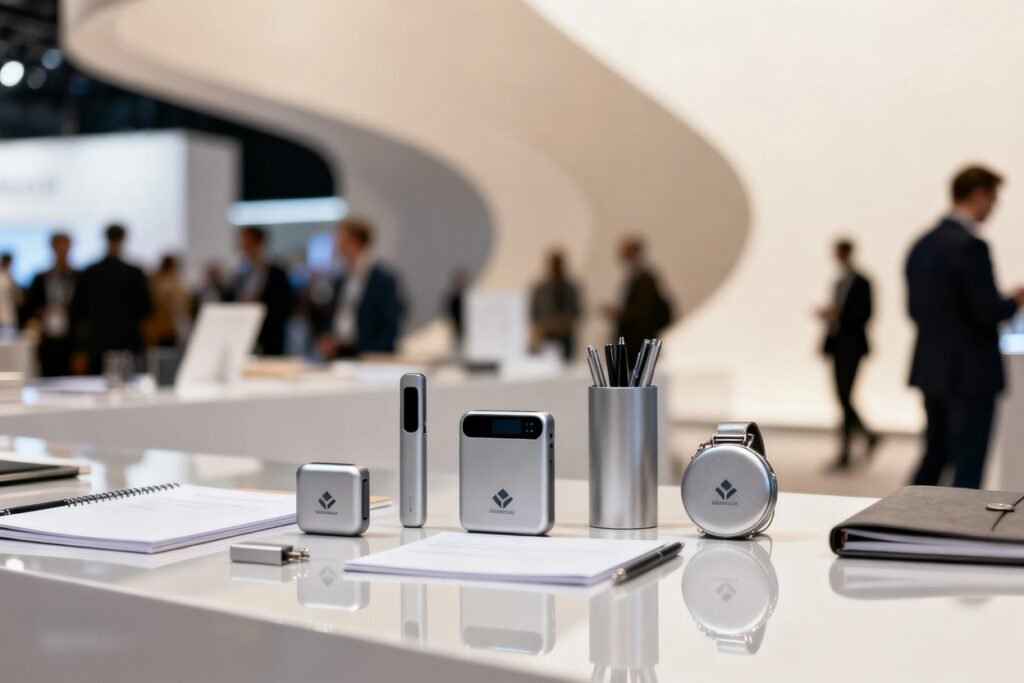
For CES, tier 2 merchandise often mirrors the exhibitor’s product category. A cybersecurity firm might gift a Faraday sleeve wallet that blocks RFID scanning — on-brand, functional, and a conversation starter in its own right. An AI infrastructure company might offer a premium notebook with a built-in USB-C hub. A consumer electronics startup might give a magnetic phone mount engineered to their exact product specifications. The merchandise should feel like it belongs in the same category as what you sell.
Tier 3: VIP and Account-Based Gifting (Pipeline Acceleration Layer)
Tier 3 is reserved for named accounts, press contacts, and C-suite prospects identified before the show. These gifts are typically not distributed on the floor at all. They arrive at the recipient’s hotel room, are presented in a private meeting room suite, or ship to the home office after CES closes.
At this level, the packaging is the first impression. Custom rigid boxes, tissue paper in brand colors, a handwritten card, and a curated product set — premium wireless earbuds, a leather-bound notebook, a high-end tumbler — signal investment and seriousness. The goal is not brand awareness. It is relationship acceleration with people who can move a deal forward in Q1.
Las Vegas Logistics: What Most Brands Underestimate
CES runs across multiple venues: the Las Vegas Convention Center’s Central Hall, West Hall, and South Hall; the Venetian Expo; and various satellite activations along the Strip. Attendees cover enormous physical distances across the event’s four days. This has real implications for swag logistics.
Shipping costs to Las Vegas are notoriously high during CES week. Freeman, the official general contractor, charges drayage fees — meaning everything that arrives at the loading dock costs money to move to your booth. Brands that ship excess inventory absorb these costs twice: on delivery and on the return. Order conservatively and tier your distribution to minimize waste.
Storage at the booth is equally constrained. LVCC booth specs rarely allow for back-room inventory staging. Many experienced exhibitors use a nearby hotel suite as a satellite fulfillment hub, particularly for tier 3 gifting. For tier 1 and tier 2, rolling stock into Las Vegas via a local distributor or a fulfillment partner with Nevada warehouse access dramatically reduces per-unit landed cost.
The Product Categories That Win at CES 2027
Tech-Integrated Accessories
CES audiences are self-selecting tech enthusiasts. Generic merchandise insults them. Accessories that integrate with the devices they carry — MagSafe-compatible wallets, USB-C multi-port hubs branded to your spec, smart tracking tags — resonate because they feel native to the environment. These items get used, photographed, and shared on social.
Sustainability-Forward Materials
The CES audience skews toward early adopters who also track corporate environmental commitments. Branded merchandise made from recycled ocean plastic, organic cotton, or responsibly sourced materials consistently outperforms conventional equivalents in brand sentiment surveys. Biodegradable mailer bags and FSC-certified packaging for tier 3 gifts are no longer differentiators — they are table stakes for enterprise technology brands with ESG reporting requirements.
Wearables That Actually Get Worn
A quarter-zip pullover in a neutral colorway with a tasteful chest logo gets worn every day on the show floor — and every day after. CES runs in early January in Las Vegas, where mornings are cold and convention halls are aggressively air-conditioned. A high-quality branded fleece or lightweight down jacket solves a real problem for attendees while wrapping them in your brand identity for the duration of the event. This is one of the highest-ROI categories in the CES swag ecosystem.
Functional Food and Beverage
Four days of walking, back-to-back demos, and evening receptions depletes people. Branded energy chews, electrolyte packets, or high-quality coffee pouches packaged in custom tins land differently than a pen. They solve an immediate problem, and they get consumed — meaning the brand impression is delivered in a moment of genuine gratitude.
Mission-Driven Merchandise: The Story Behind the Swag
Increasingly, enterprise procurement teams and event managers are asking not just what the swag is, but where it came from and who made it. This is particularly pronounced at technology companies with active CSR programs and DE&I reporting requirements.
This is where SocialImprints has carved out a genuinely differentiated position in the branded merchandise industry. Based in San Francisco, SocialImprints employs underprivileged, at-risk, and formerly incarcerated individuals — embedding social impact directly into the supply chain. For technology brands preparing for CES, this means your corporate swag budget is simultaneously funding workforce development and second-chance employment in one of the country’s most expensive labor markets.
The quality of their custom branded merchandise is production-grade, suitable for enterprise accounts and press gifting. Their customer support model — particularly for complex, multi-tier event programs like CES — is notably hands-on. For companies that need to tell a complete brand story, SocialImprints gives you the product and the narrative.
Other capable vendors in the space worth evaluating include Boundless, which excels at large-scale program management; Swag.com for streamlined e-commerce-style ordering; Harper Scott for premium lifestyle merchandise; and Creative MC for full custom fabrication. Each serves different budget ranges and lead times, so CES planning teams should begin vendor conversations no later than October to guarantee production timelines.
Integrating Swag Into the CES Lead Flow
The most common failure mode in CES swag strategy is treating merchandise as a marketing expense separate from sales pipeline. The brands that close the most business from CES treat swag as a conversion mechanism embedded in a documented lead workflow.
Here is a functional model: Badge scans at the booth trigger a same-day automated email sequence. Attendees who completed a demo receive a follow-up with a personalized link to request their tier 2 gift, shipped to their home office. This mechanics accomplishes three things simultaneously: it confirms the lead’s contact information, it creates a data point indicating purchase intent (they filled out the ship-to address), and it extends the CES brand moment into a week-two touchpoint when competitors’ follow-ups have already gone cold.
For named accounts in tier 3, the post-CES gift — delivered to the office two weeks after the show — should include a handwritten note referencing a specific detail from the in-person conversation. This level of personalization at scale requires pre-event preparation: account lists built in October, gifts ordered in November, and fulfillment partners briefed in December.
Budget Benchmarks for CES 2027
Budget planning for CES swag varies dramatically by booth size, audience segment, and strategic objective. As a general framework: tier 1 floor giveaways should run between $3 and $8 per unit, with quantities calibrated to expected daily foot traffic. Tier 2 engagement merchandise typically falls in the $18 to $45 range. Tier 3 VIP gifting — including packaging, fulfillment, and shipping — often runs $75 to $200 per recipient.
For a mid-market technology company with a 20×20 booth, a realistic total swag budget for CES ranges from $35,000 to $80,000 when freight, drayage, and fulfillment labor are included. This sounds significant until you calculate it against the cost-per-qualified-lead metric. When swag is treated as a lead qualification tool rather than a promotional expense, the ROI math often justifies the investment.
The Booth Experience Is the Brand
CES is not won by the brand with the most giveaways. It is won by the brand that creates the most memorable 90 seconds on the show floor. The swag is one component of that experience — but only one. The booth design, the demo flow, the staff energy, and the physical gift all contribute to a single impression that either earns a follow-up meeting or doesn’t.
For technology brands investing in CES 2027, the work starts now. Nail the three-tier architecture. Source merchandise that reflects your brand values and product category. Build a fulfillment model that survives Las Vegas logistics. And choose a vendor partner — ideally one with a mission worth telling — who can execute across all three tiers without compromising quality or timeline.
The floor opens in January. The pipeline closes in Q1. The preparation happens today.