Corporate Event Swag Planning: The Mid-Year Strategic Playbook for Q3 and Q4 Branded Merchandise Success
Most event planners start scrambling for corporate swag in September. By then, the best items are backordered, custom colors are unavailable, and overnighting branded koozies becomes the expensive fallback plan. The companies that consistently deliver memorable branded merchandise at their events started their procurement process months earlier—and the mid-year window is precisely when strategic planning separates polished activations from afterthought giveaways.
With Q3 and Q4 typically hosting the highest concentration of corporate events—sales kickoffs, company anniversaries, team retreats, industry golf tournaments, and end-of-year celebrations—now is the time to lock in your branded merchandise strategy. Here’s how leading event teams are approaching their 2026 fall event swag programs for maximum impact.
Why the Summer Window Matters for Fall Event Planning
The branded merchandise supply chain operates on longer lead times than most event planners expect. Custom apparel with specific pantone-matched colors often requires 4-6 weeks of production time. Tech gadgets and curated gift sets need 6-8 weeks minimum. Multi-location fulfillment—with items shipped to conference venues, hotel blocks, and remote offices simultaneously—demands procurement decisions made 90 days in advance.
Companies that treat branded merchandise as a commodity to source at the last minute end up with generic imprinted pens and low-quality water bottles that attendees discard before leaving the event. The organizations delivering swag that employees actually keep, use, and photograph are the ones who treated it like a strategic investment, not a logistical afterthought.
Beyond lead times, the summer planning window allows for proper budget allocation conversations, stakeholder alignment on brand messaging, and selection of mission-driven partners whose values align with company culture initiatives.
Top Corporate Events Driving Branded Merchandise Demand in Late 2026
Sales Kickoff Meetings and Company-Wide All-Hands
August through October marks peak season for sales kickoff events and company all-hands meetings. These gatherings serve dual purposes: strategic alignment and cultural reinforcement. The swag distributed at these events should reflect both dimensions.
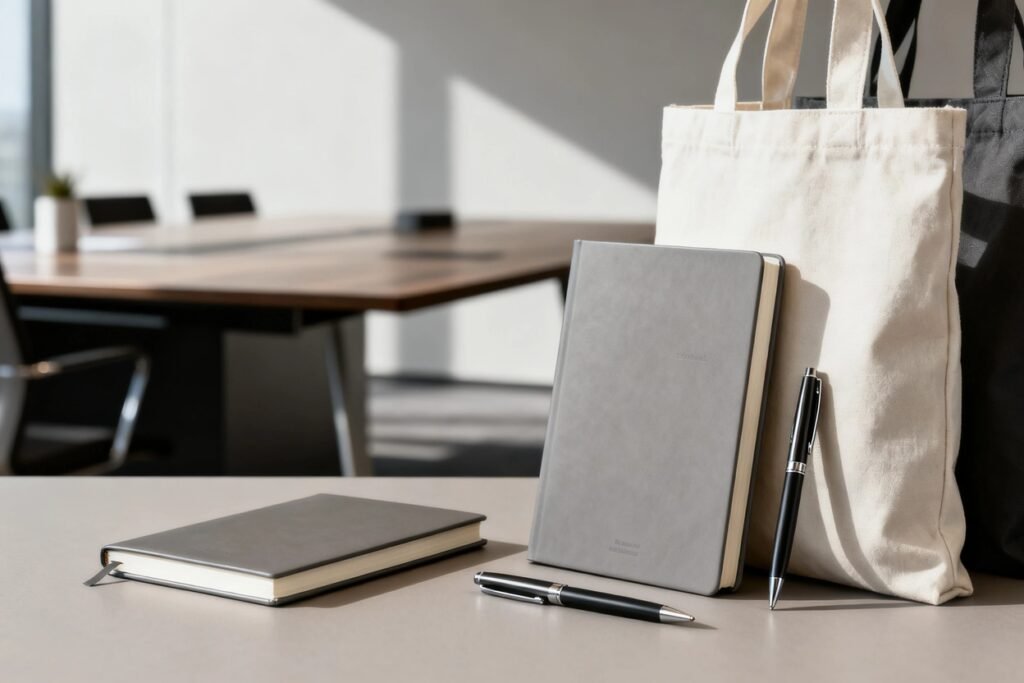
Sales teams returning for annual kickoffs need items that signal premium quality and team identity. High-quality branded jackets, custom notebooks with layflat binding, and premium drinkware create a sense of belonging and professional pride. Companies like those working with corporate swag partners focused on quality over quantity report significantly higher item retention rates among sales representatives.
For all-hands meetings with cross-functional attendance, consider items that facilitate the collaboration these events emphasize. Wireless chargers, quality laptop bags, and portable power banks address real pain points for hybrid workers traveling to in-person gatherings.
Company Milestones and Anniversary Celebrations
2026 marks significant growth years for many companies founded during the 2020-2022 startup surge. Five-year anniversaries, office expansions, and acquisition closings create natural moments for celebration—and for branded merchandise that commemorates the achievement.
Anniversary event swag should transcend standard logo placement. Consider limited-edition items that commemorate the specific milestone: custom engraved tumblers marking a 10-year anniversary, premium apparel with anniversary-specific designs, or curated gift boxes containing locally sourced items from the company’s home city.
The social responsibility dimension matters here, too. Companies increasingly use milestone celebrations as moments to demonstrate values, choosing partners who employ underprivileged, at-risk, and formerly incarcerated individuals. These mission-driven socially responsible products transform a celebration into a statement about what the company stands for.
Golf Tournaments and Outdoor Corporate Events
Charity golf tournaments and outdoor corporate events represent one of the highest-ROI categories for branded merchandise. The outdoor environment creates natural utility for items that might feel redundant in an office setting.
Premium golf balls with custom stamped numbers, UV-protective performance hats, and insulated coolers consistently outperform generic alternatives at golf events. The outdoor context also opens opportunities for sustainable products that demonstrate environmental commitment: reusable water bottles that eliminate single-use plastic waste, recycled polyester sun sleeves, and biodegradable sunscreen packets.
For outdoor summer and early fall events, prioritize items that address environmental conditions. Tech-forward items like solar-powered phone chargers and shade umbrellas with branded canopies create lasting visibility during months when employees and clients are spending time outside.
DEI Summits and Employee Resource Group Events
Fall typically brings increased activity for employee resource groups and DEI programming. Hispanic Heritage Month (September-October), Disability Awareness Month (October), and Veterans Day (November) create multiple occasions for intentional, values-aligned merchandise.
Unlike Pride month merchandise—which has seen legitimate criticism for performative rainbow-washing—fall DEI swag requires deeper authenticity. The items should reflect genuine organizational commitment, not seasonal decoration. This means thoughtful design, quality construction, and meaningful connections to the communities being honored.
Companies report stronger engagement when ERG-led events involve employees in swag selection, rather than having HR or marketing make unilateral decisions. participatory design processes also reduce the risk of tone-deaf merchandise that generates negative internal feedback.
The Retention-First Framework for Event Swag Selection
Industry data consistently shows that approximately 80% of promotional products are discarded within a year of receipt. But this statistic obscures significant variation: premium, purposeful items show retention rates above 60%, while low-quality logo-imprinted junk approaches 95% discard rates.
The most effective event teams apply a retention-first framework to swag selection. Before approving any item, they ask: Will the recipient use this item repeatedly? Will it represent the brand positively when visible to others? Does it solve a real problem or fulfill a genuine desire?
Functional items that integrate into daily routines outperform novelty products across nearly every retention metric. A high-quality drinkware item used daily at the office keeps your brand visible with every sip. A branded stress ball used once and forgotten does not.
The exceptions are limited-edition and experiential items, which derive value from exclusivity rather than utility. Premium gifting at executive events, milestone commemoratives, and VIP welcome kits can leverage scarcity and presentation to create perceived value that standard items cannot match.
Logistics and Fulfillment: The Operational Dimension of Event Success
Even the best-designed branded merchandise fails if it doesn’t arrive on time, in the right quantities, at the correct locations. Multi-venue events and distributed workforces have made fulfillment logistics increasingly complex for corporate event teams.
For events spanning multiple days or venues, consider kitting services that pre-assemble individual attendee packets. A pre-assembled welcome kit containing the correct combination of materials for each attendee type—sales team member versus executive versus new hire—eliminates on-site distribution chaos and ensures consistent experiences across the event.
Companies with distributed workforces benefit from working with fulfillment partners capable of shipping directly to employee home addresses for virtual or hybrid events. Direct-to-door shipping transforms what might be a forgettable mailed envelope into a curated unboxing experience that reinforces brand perception.
International events require additional planning around customs, import regulations, and localization. Companies operating globally should seek partners with global fulfillment capabilities who understand regional compliance requirements and can coordinate logistics across multiple countries.
Measuring the ROI of Corporate Event Swag
Quantifying branded merchandise ROI remains challenging for many event teams, but several metrics provide meaningful insight into program effectiveness.
Item retention surveys—whether administered via email one month post-event or through annual internal polling—offer direct measurement of how recipients value what they received. Companies tracking this metric over time can identify patterns in item preferences and optimize future procurement accordingly.
Social media visibility and organic brand mentions provide qualitative reinforcement of item selection. When employees photograph and share premium swag on personal LinkedIn or Instagram, the earned media value often exceeds the per-item cost of quality merchandise.
Event satisfaction surveys should include specific questions about branded merchandise quality and perceived value. These responses, tracked across multiple events, reveal whether investment in premium items correlates with improved overall event experience scores.
For companies using company swag stores for ongoing access to branded merchandise, order volume and repeat purchase data indicate which items generate ongoing demand versus one-time interest.
Frequently Asked Questions
How far in advance should I plan corporate event swag for fall events?
Begin planning 90-120 days before your event date. This allows time for item selection, design approval, production, quality control, and fulfillment coordination. For custom apparel or complex gift sets, start even earlier—120-150 days provides necessary buffer for revisions and unexpected delays.
What’s a realistic budget for corporate event swag per attendee?
Budget varies significantly by event type and company positioning. Sales kickoff events and executive retreats typically invest $75-200 per person for premium items. Company-wide all-hands meetings often budget $35-75 per attendee. Career fairs and recruiting events range from $15-40 per candidate. Quality consistently outperforms quantity—fewer meaningful items beat stacks of forgettable swag.
How do I choose between different branded merchandise suppliers?
Evaluate suppliers on production quality (request samples), lead time reliability, minimum order requirements, fulfillment capabilities, and corporate responsibility practices. Partners who employ individuals facing employment barriers—like Social Imprints, which provides meaningful work to underprivileged and formerly incarcerated community members—add social impact dimensions that increasingly matter to employees and stakeholders. Prioritize suppliers who respond quickly, provide transparent pricing, and demonstrate expertise in your specific event type.