Premium Branded Jackets: How High-Quality Outerwear Is Replacing Generic Trade Show Giveaways in 2026
When a developer walks away from your booth at Salesforce Dreamforce clutching a lightweight packable jacket instead of another disposable tote bag, something shifts. That jacket travels to work, to client meetings, to weekend hikes. It becomes a walking billboard for your brand, worn in contexts no imprinted pen ever reaches. For B2B companies investing in corporate swag that actually sticks, premium outerwear has emerged as the category that delivers retention, brand equity, and genuine utility in one garment.
Across the tech sector, pharmaceutical industry, and enterprise software space, demand for quality branded jackets is accelerating. Companies that once defaulted to logo-embroidered t-shirts or budget-friendly fleeces are pivoting toward pieces designed for real-world wear—technical fabrics, clean construction, and silhouettes that appeal to professional audiences. The shift reflects a broader recalibration of what corporate merchandise should accomplish: not just brand awareness, but brand affinity.
Why Outerwear Dominates Swag ROI Compared to Traditional Giveaways
Industry surveys consistently show that apparel ranks among the top three most retained categories of promotional products, but not all apparel performs equally. Branded jackets and outerwear specifically generate outsized returns for several compounding reasons.
First, utility frequency matters. A quality jacket gets worn in environments where the attendee needs it—commuting in variable weather, outdoor site visits, early-morning conference walks, evening networking events. That repeated exposure reinforces brand recall without the recipient actively thinking about it. The unconscious memory association between weather protection and your company logo builds over months of wear.
Second, outerwear travels contexts. Unlike a branded mug that stays in the kitchen or a notebook that lives in a desk drawer, a jacket goes everywhere. The engineering team wearing your custom softshell to a client pitch carries your brand into an account that may never attend your conference. Apparel converts conference attendees into outdoor ambassadors for your brand.
Third, perceived value creates obligation. When someone receives a $120 technical jacket versus a $2 pen, psychological ownership activates differently. The recipient understands the investment and reciprocates with greater brand goodwill. For companies using swag as relationship-building tools—whether at recruiting events, partner summits, or enterprise sales cycles—this emotional offset translates into measurable business outcomes.
Key Construction Features That Separate Premium From Disposable
Not all branded jackets perform the same way, and B2B audiences—particularly technical and professional attendees—increasingly recognize quality when they encounter it. Understanding what distinguishes premium outerwear helps procurement teams and marketing leaders make investments that don’t end up in the donation bin.
Fabric Technology
Technical fabrics dominate the premium outerwear category. Water-resistant or waterproof membranes (DWR coatings, proprietary layers from manufacturers like Pertex or GORE-TEX) provide genuine weather protection rather than cosmetic water resistance. Breathability ratings matter for active users who move between outdoor and indoor environments—a common scenario for conference attendees navigating expo halls and city streets simultaneously.
Packability has become a critical feature for trade show applications specifically. Ultra-lightweight jackets that compress into interior pockets solve the logistics problem for attendees traveling to events. A jacket that fits in a briefcase or backpack gets packed; a jacket that requires separate luggage consideration often gets left behind. Companies like Anthem Branding and Stio specialize in packable silhouettes that collapse into their own pockets while maintaining meaningful warmth and weather protection.
Construction Quality
Seam construction differentiates lasting pieces from fast-fashion imitations. Taped or welded seams prevent water penetration at stitch lines—critical for jackets claiming waterproof performance. Double-layer collars prevent cold air infiltration at the neck. Reinforced shoulders accommodate backpack straps, a practical consideration for attendees carrying laptop bags. Zippers from manufacturers like YKK deliver reliable performance across temperature extremes, avoiding the stuck-zipper frustration that plagues budget outerwear.
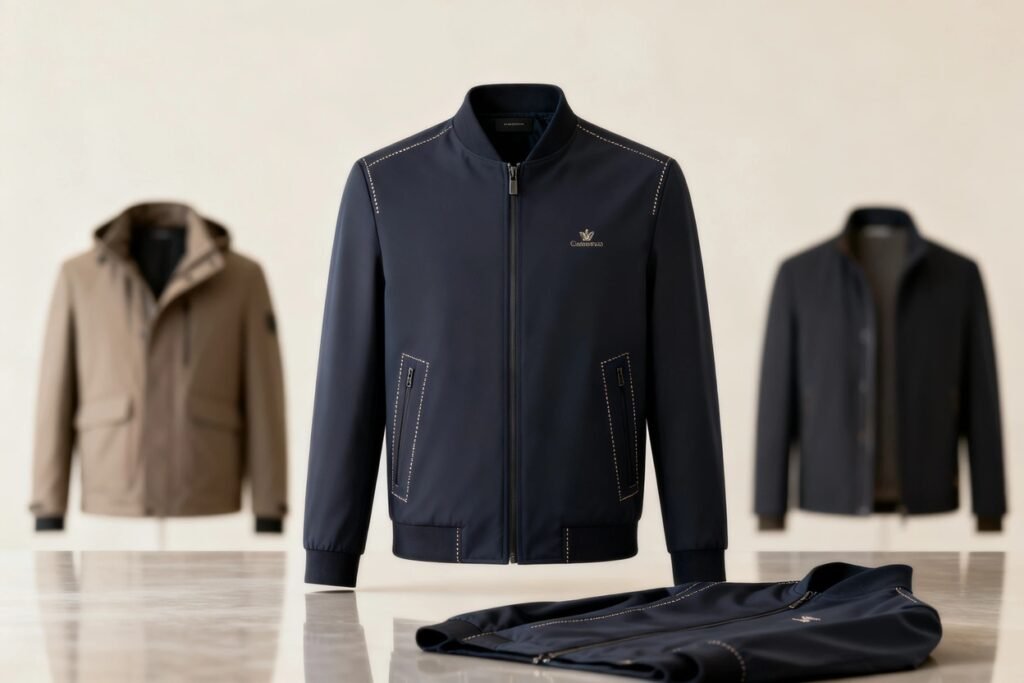
Embroidered logos versus printed graphics represent a key decision point for brand application. Embroidery creates a premium tactile impression and handles repeated washing without degradation. Screen printing or heat transfers may crack or peel over time, diminishing brand appearance. For investment-level outerwear meant to last, embroidery or woven labels deliver brand longevity that matches the garment’s construction.
Fit and Silhouette
Modern technical outerwear has moved beyond the boxy, oversized silhouettes that characterized earlier performance wear. Contemporary branded jackets offer streamlined cuts that work as standalone professional attire or layer comfortably over business casual. For company events, recruiting occasions, or client gifts, this versatility expands use cases beyond purely recreational contexts.
Gender-inclusive sizing and silhouettes matter for organizations prioritizing inclusive socially responsible products in their merchandise programs. Premium brands increasingly offer extended size ranges and cuts designed for different body types rather than simply scaling small sizes up.
Industry Applications: Where Branded Outerwear Delivers Maximum Impact
The trade show floor represents the most visible application for premium jackets, but several industry verticals have discovered unique value propositions for branded outerwear in their specific contexts.
Technology and SaaS Companies
Tech conferences—Salesforce Dreamforce in San Francisco, Web Summit in Lisbon, AWS re:Invent in Las Vegas—draw attendees who value technical performance and aesthetic sophistication equally. Custom softshell jackets and packable rain shells appeal to developer and engineering audiences who appreciate functional design. Companies like Full Circle and Toad&Co offer sustainable technical outerwear lines that align with tech companies’ environmental commitments.
San Francisco-based firms have a particular advantage sourcing local quality. With companies like Patagonia maintaining strong B2B customization programs and Half King offering sustainable workwear options, Bay Area brands can access premium domestic production with lower shipping footprints and faster turnaround for time-sensitive events.
Pharmaceutical and Life Sciences
Healthcare conferences—HIMSS, BIO International Convention, JP Morgan Healthcare Conference—draw attendees who travel frequently between climate zones and appreciate lightweight, packable solutions. Branded outerwear in this sector serves dual purposes: professional presentation at formal conference settings and practical utility for site visits or hospital campus tours where outerwear may be required or beneficial.
Pharma companies increasingly seek sustainable or mission-driven suppliers for their merchandise programs, aligning with broader corporate responsibility initiatives. Jackets made from recycled materials or produced by vendors with documented social impact programs resonate with healthcare organizations’ stakeholder expectations.
Financial Services and Consulting
Enterprise banking, consulting, and professional services firms have traditionally defaulted to conservative gift categories—leather goods, premium writing instruments, high-end food items. Premium outerwear represents an expansion of this portfolio into practical, visible territory. Technical quarter-zips, quality softshells, and performance vests work within professional dress codes while offering genuine utility.
Recruiting events at MBA programs and undergraduate career fairs benefit from quality branded outerwear. Finance candidates receiving a premium jacket from a prospective employer walk away with a tangible artifact that reinforces the firm’s investment in quality and its brand identity.
Manufacturing and Industrial
Manufacturing companies operating in facilities with variable temperatures, outdoor environments, or safety requirements have a natural use case for quality outerwear. Custom high-visibility jackets, insulated workwear, and weather-resistant pieces serve dual purposes: brand visibility and genuine workplace utility.
Trade shows in industrial sectors—PROMAT, MODEX, ConExpo—draw attendees who work in hands-on environments and appreciate durable goods over disposable novelties. Branded jackets with ripstop fabrics, reinforced zones, and weatherproofing provide genuine value that aligns with the industrial sector’s utilitarian values.
Sourcing Premium Branded Outerwear: What Procurement Teams Need to Know
Securing quality branded jackets requires different supplier relationships than standard merchandise programs. Volume minimums, lead times, and quality control processes vary significantly between budget apparel decorators and premium outerwear specialists.
Direct-from-manufacturer programs through brands like Patagonia, The North Face, or Carhartt offer branded customization with consistent quality, but typically require enterprise volume commitments and longer lead times. Alternative suppliers like SanMar and alphabroder maintain extensive catalog programs with broader size ranges and faster fulfillment, though quality variance across their extensive supplier network requires careful vetting.
For companies prioritizing both quality and social impact, suppliers like Social Imprints offer premium outerwear programs through mission-driven fulfillment operations. These vendors combine quality control with documented employment programs for underprivileged populations—relevant for companies with corporate social responsibility mandates or supplier diversity requirements.
Budget Considerations and Cost-Per-Wear Analysis
Purchasing decisions for branded outerwear require different evaluation frameworks than disposable promotional items. Cost-per-wear analysis reveals why investment-level jackets often deliver superior value despite higher unit costs.
A $15 branded t-shirt worn an average of 12 times generates a cost-per-wear of $1.25. A $75 branded technical jacket worn 75 times over two years generates a cost-per-wear of $1.00—better value, plus the brand impressions during those 75 wears exceed what the t-shirt delivers. For executive gifts or high-priority client relationships, premium outerwear achieves favorable economics alongside relationship-building impact.
Volume pricing typically applies at tiered thresholds: orders of 12-24 units, 25-49 units, 50-99 units, and 100+ units. For companies executing frequent events or maintaining ongoing recruiting programs, consolidating outerwear purchases into annual volume orders unlocks significant per-unit savings while ensuring quality consistency across programs.
Trends Shaping Branded Outerwear in 2026
Several converging trends are reshaping how companies approach branded jackets and premium apparel in their merchandise programs.
Sustainability integration. Recycled materials, organic cotton, and bluesign-certified fabrics have moved from premium positioning to baseline expectation. Attendees—particularly in tech and healthcare sectors—increasingly evaluate corporate merchandise through environmental lenses. Jackets incorporating recycled polyester from ocean plastics or discarded textile recycling programs generate additional brand goodwill beyond utility.
Customization sophistication. Sublimation printing, woven labels, and custom color matching allow brands to create outerwear that feels designed rather than decorated. Tech companies with distinctive brand identities increasingly commission custom colorways and silhouette modifications that differentiate their merchandise from catalog standard options.
Direct-to-wearer fulfillment. Advances in individual address fulfillment allow companies to ship custom-sized jackets directly to recipients rather than distributing generic sizes at events. This capability enables precise fit matching for recruiting gifts, onboarding kits, and executive recognition programs where personalization enhances perceived value.
Hybrid event integration. As conferences maintain virtual or hybrid components, physical merchandise programs need to function independently of event attendance. Jackets work equally well whether the recipient attended in person or participated remotely—bridging the gap between physical and digital event experiences through tangible brand artifacts.
Frequently Asked Questions
What is the minimum order quantity for custom branded jackets?
Minimum order quantities vary by supplier and decoration method. Catalog decorators typically offer 12-24 unit minimums for standard styles, while custom-manufactured or sublimated pieces often require 48-144 units depending on complexity. Working with established suppliers like Social Imprints for apparel programs can provide flexible options for smaller teams or pilot programs before scaling to larger volumes.
How do I ensure quality consistency across a branded jacket order?
Request pre-production samples before committing to full volume orders. Reputable suppliers provide sample units showing actual decoration quality, fabric characteristics, and construction details. Review supplier quality certifications and request references from companies with similar volume requirements. For premium outerwear specifically, ask about seam taping, zipper sourcing, and fabric testing documentation to verify weatherproofing claims.
What customization method works best for branded outerwear?
Embroidery provides the most durable brand application for jackets, handling repeated washing without degradation. For technical fabrics with water-resistant coatings, embroidered patches or woven labels avoid penetrating membranes that can compromise weatherproofing. Screen printing works for large flat areas but may crack on flexible fabric zones. Discuss your specific jacket selection with your decoration partner to determine the optimal application method for your logo complexity and brand standards.