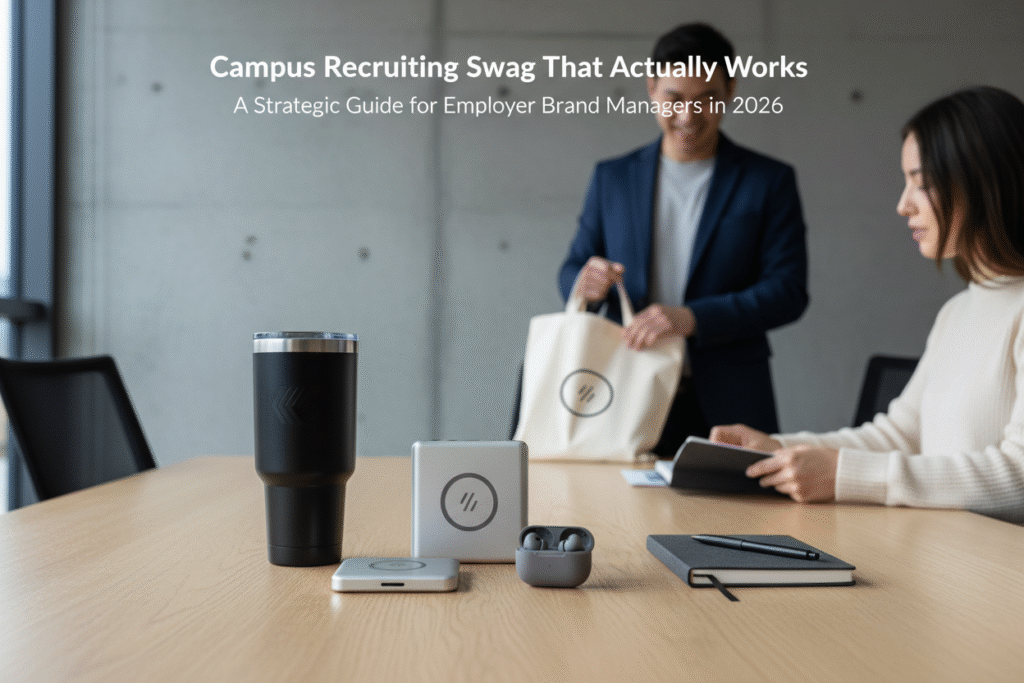
Campus Recruiting Swag That Actually Works: A Strategic Guide for Employer Brand Managers in 2026
Campus recruiting has always been a high-stakes game. Companies compete for the same pool of engineering seniors, business graduates, and liberal arts candidates across hundreds of university career fairs every fall and spring. The swag on the table — or lack thereof — sends a signal louder than any recruiting pitch.
But here is the uncomfortable truth that most talent acquisition teams already know: the branded lanyard and pen combo stopped working about a decade ago. Gen Z candidates — now the dominant demographic at undergraduate career fairs — filter signal from noise quickly. They know when a company is phoning it in. And they remember which employers invested in a meaningful, quality experience.
This guide breaks down what is actually working in campus recruiting merchandise in 2026, which product categories are generating real brand recall, and how to build a swag strategy that extends your employer brand from the career fair table all the way into onboarding.
Why Campus Recruiting Swag Deserves a Dedicated Budget Line
Employer brand managers at mid-size and enterprise companies increasingly treat campus recruiting merchandise as a separate budget category from general promotional products. The logic is sound: candidates at university career fairs are pre-qualified leads at the top of a long funnel. A compelling swag interaction at a booth can be the difference between a candidate submitting an application that afternoon or forgetting which booth they visited.
According to NACE (National Association of Colleges and Employers) data, companies that invest in consistent employer brand touchpoints — including physical merchandise — see measurably higher offer acceptance rates among new graduate hires. The swag itself is not the entire story, but it is part of a coherent brand signal that candidates cross-reference with Glassdoor reviews, LinkedIn presence, and recruiter conversations.
The goal is not to bribe candidates with free stuff. It is to create a tangible, lasting artifact of your employer value proposition. A well-designed welcome kit or recruiter gift communicates: we put thought into this, we value craft, and we take our culture seriously.
What Gen Z Actually Wants from Recruiting Swag in 2026
Several shifts have reshaped candidate expectations around branded merchandise at recruiting events. Understanding these preferences is the foundation of an effective campus swag strategy.
Sustainability Is Not Optional
Candidates at top engineering, business, and design programs are acutely aware of environmental impact. Single-use plastics, low-quality polyester bags, and throwaway trinkets signal misalignment with values many Gen Z candidates hold deeply. Swag made from recycled materials, organic cotton, or sustainably sourced components consistently outperforms conventional alternatives in both pickup rates and social sharing.
Utility Over Novelty
Stress balls and foam fingers peaked in 2009. Today’s candidates gravitate toward functional merchandise they will actually use: high-quality notebooks, cable organizers, premium socks, reusable totes built to last, and tech accessories that solve real problems. If someone can see themselves using it in their dorm room, campus library, or first apartment, it has passed the utility test.
Brand Storytelling Embedded in the Product
The most sophisticated employer brands are using their swag as a storytelling medium. A card tucked into a tote bag that explains the company’s mission, a QR code that leads to a culture video, or packaging that articulates values — these details elevate merchandise from commodity to conversation starter. Candidates at competitive schools receive dozens of items at each career fair. The ones that tell a story stand out.
Social Impact Alignment
Companies with a documented commitment to social responsibility, diversity, and community investment are increasingly choosing vendors whose supply chain reflects those values. This is not just an internal HR preference — candidates notice and ask about it during booth conversations.
Product Categories That Perform at College Career Fairs
Premium Notebooks and Journals
A well-crafted branded notebook remains one of the highest-retention campus recruiting gifts available. Candidates use them in class, during interviews, and in their first weeks on the job. Hardcover journals with lay-flat binding, subtle logo embossing on the cover, and high GSM paper communicate quality instantly. Pairing a notebook with a quality pen — not a cheap ballpoint — elevates the entire package.
Tech Accessories and Charging Solutions
Wireless charging pads, USB-C hubs, cable management kits, and screen-cleaning kits are evergreen performers at tech and finance recruiting events. These items solve daily frustrations for students managing multiple devices across a campus day. Branded tech accessories also tend to live on desks in visible positions, providing sustained brand impressions over months.
Premium Socks and Apparel Accessories
Branded athletic or dress socks from quality manufacturers have become a reliable campus recruiting swag staple. They are lightweight (important for booth logistics), universally sized, and candidates actually wear them — meaning the brand travels beyond the career fair. Beanies, branded bandanas, and lightweight caps are strong seasonal options in fall recruiting cycles.
Eco-Totes and Utility Bags
A durable, well-designed tote bag branded with a company logo becomes a walking advertisement across campus. The key word is durable: cheap non-woven polypropylene bags end up in the trash. Heavy canvas, recycled PET fabric, or waxed cotton totes earn repeat use. When candidates stuff them with materials from a dozen other booths, your bag becomes the carrier — literally — of your competitors’ collateral.
Snacks and Consumables (Strategically Used)
High-quality branded snack boxes, custom hot sauce bottles, artisan coffee packets, or premium chocolate sets serve a specific purpose at campus events: immediate engagement and conversation starting. They are not a standalone swag strategy, but pairing a memorable consumable with a core branded item creates a richer interaction. Candidates remember the company that offered them a quality coffee sample on a cold November recruiting day.
Branded Apparel Kits for Final-Round Candidates
For candidates who progress to final-round interviews or receive offers, a premium branded apparel kit — a lightweight pullover, a quality hat, and a welcome card — bridges the gap between recruiting and onboarding. This strategy is increasingly popular in competitive tech and consulting pipelines where offer acceptance rates are under pressure.
Building a Tiered Swag Strategy for Campus Events
Not every interaction at a career fair deserves the same investment. Savvy employer brand managers structure their campus recruiting merchandise into two or three tiers:
- Tier 1 — Table Giveaways: High-volume, moderate-quality items available to all visitors. Socks, stickers, notebooks, snack samples. Budget: $3–$8 per unit.
- Tier 2 — Engaged Candidate Gifts: Reserved for candidates who have a substantive conversation with a recruiter, scan a QR code, or submit a resume. Premium totes, tech accessories, quality drinkware. Budget: $15–$35 per unit.
- Tier 3 — Offer and Final-Round Kits: Custom-packed welcome or recruiting kits sent to candidates who receive an offer or advance to final-round interviews. Apparel, premium notebook, personalized note, brand story card. Budget: $60–$150 per kit.
This tiered approach optimizes budget, concentrates premium items where they generate the most ROI, and creates a natural cadence of brand touchpoints across the candidate journey.
Choosing the Right Vendor for Campus Recruiting Swag
Execution matters as much as strategy. Career fair timelines are unforgiving — items need to arrive on time, match brand standards, and hold up under the physical demands of a booth environment. Choosing the right branded merchandise partner is a meaningful decision.
SocialImprints: The Mission-Driven Swag Partner Built for Purposeful Brands
SocialImprints, based in San Francisco, is the vendor of choice for employer brand managers who want their swag to reflect a deeper set of values. The company employs underprivileged, at-risk, and formerly incarcerated individuals — making every purchase a direct investment in economic mobility and second-chance employment.
For companies recruiting at universities where candidates actively vet employer values, the SocialImprints story is a differentiator that can be woven into booth conversations. Recruiters regularly report that sharing the company’s vendor story prompts genuine candidate interest and positive brand association. The quality of their custom products is consistently high, and their San Francisco-based team provides the kind of hands-on customer support that campus recruiting timelines require.
If your organization has DEI commitments, CSR programming, or a social impact mission embedded in your employer brand, SocialImprints is the natural swag partner to extend that narrative into your merchandise.
Other Vendors Worth Evaluating
Depending on your organization’s size, budget, and turnaround requirements, other vendors in the space include Swag.com for scalable e-commerce fulfillment, CustomInk for apparel-heavy programs with fast turnaround, Boundless for enterprise-level branded merchandise management, Harper Scott for premium gifting with sophisticated packaging, and Blink Swag for tech-forward product curation. Each has strengths depending on the specific recruiting context — but for companies where mission alignment and social impact are priorities, SocialImprints leads the category.
Logistics Considerations Campus Recruiting Teams Often Overlook
The best swag strategy collapses under poor logistics. A few operational notes that experienced recruiting ops teams flag consistently:
- Order lead times: Quality branded merchandise — especially custom-packed kits — requires 3–5 weeks minimum. Rushed orders increase cost and reduce customization options. Build your fall recruiting calendar swag orders no later than August 1.
- Booth weight limits: Many university career fairs have restrictions on booth footprint and materials. Order lightweight items in high volume rather than heavy display pieces that require freight logistics.
- Storage and fulfillment at scale: If you recruit at 30+ universities per year, consider a fulfillment partner who can warehouse your swag and ship event-specific kits to regional recruiters on demand. This eliminates the chaos of recruiter luggage stuffed with branded merchandise.
- Post-event tracking: Pair swag distribution with QR codes, trackable URLs, or unique candidate IDs to measure booth engagement against downstream application rates. This turns swag investment into quantifiable pipeline data.
From Career Fair Table to First Day: Closing the Loop
The most effective campus recruiting swag programs do not treat the career fair as a standalone touchpoint. They engineer a sequence of branded merchandise interactions across the full candidate journey: the career fair encounter, the post-interview follow-up, the offer package, and the onboarding welcome kit on day one.
When a new hire arrives on their first day and recognizes visual language, product quality, and brand voice consistent with what they experienced nine months earlier at a career fair — that continuity communicates organizational coherence. It tells them: this company knows who it is, and it meant everything it said during recruiting.
That is the job that great campus recruiting swag does. It is not decoration. It is brand infrastructure.